|
4/17/2024 Assessing the prospects of innovation concepts, with an example from the Democratic Republic of the CongoRead Now Suppose that a manager has identified a promising concept that describes roughly how a potential product or service would work and how many resources would be required. Before progressing to develop it further, they check whether the concept will be economically viable. This blog post will describe how they can use a cashflow model to check viability, and will apply it to assess the introduction of a small supermarket in the city of Bandundu, in the west of the Democratic Republic of the Congo (D.R.C). Step 1: Estimate the time period for valuation Estimate the time in years for the innovation’s development, and for its sales (for a commercial organisation) or use (for an organisation which considers the social value of the innovation). For example, the development time may be two years and the sales period may be five years. Step 2: Estimate the costs in each year Estimate the costs that the organisation will have to pay in each year. The costs may include machinery, labour, or materials, and they could be incurred during development, preparation for production, production, or sales. Step 3: Estimate the value generated in each year Estimate the value that the innovation will generate in each year. If the innovator is a commercial organisation, this is the value of sales. If the innovator considers the social value of the innovation, this is the social value in financial terms for the innovation’s users or other people. Social value is anything about the innovation that people consider valuable, even if they do not pay for it. For example, if the innovation feeds people, that is social value whether or not they pay for it. If social value is not paid for, then its financial value must be estimated. If there are equivalent products or services on the market, their price can be used as an approximation of the social value. The price will usually underestimate it. Step 4: Estimate the net value created in each year Estimate the net value generated in each year by subtracting the costs from the value generated. Step 5: Select the discount rate d When a person or organisation has to wait for value, it is usually considered to be worth less than the same value created today. After all, if today’s value is financial (or is social value that can be converted into financial value), they could invest it and receive more value in future. The value today of a value V that emerges T years in future can be measured as V / (1 + d)^T, where d is the “discount rate”. When d is larger, today’s value is smaller. The innovator should select the discount rate depending on their circumstances. It increases if the innovator has better alternative opportunities, or if there is higher risk that the value will not emerge, or if inflation is high. In richer countries with low inflation, a typical discount rate for a large company may be around 15 percent. Step 6: Estimate the discounted net value created in each year Estimate the discounted net value generated in each year by replacing V with the estimated net value in the expression V / (1 + d)^T. Step 7: Estimate the discounted net value at the start of the innovation project Estimate the starting discounted net value by adding the estimated discounted net values for all the years. Step 8: Estimate the discounted net value with the highest costs possible Estimate the highest costs that could possibly be paid in each year. Then estimate the discounted net value as in step 7 with the values from step 3 and the discount rate from step 5, unless there is a good reason to adjust them. “Possibly” here means about a one-in-twenty chance of happening. Step 9: Estimate the discounted net value with the lowest annual values possible Estimate the lowest values that could possibly be generated in each year, and estimate the discounted net value with the costs from step 2 and the discount rate from step 5 unless there is a good reason to adjust them. Step 10: Estimate the discounted net value with the highest discount rate possible Select the highest discount rate that could possibly be appropriate, and estimate the discounted net value with the costs from step 2 and the values from step 3 unless there is a good reason to adjust them. Step 11: Assess the value of the concept The estimated discounted net value should be positive if the concept is to be developed. The estimated discounted net values with the highest costs, the lowest annual values, and the highest discount rate should be considered as well. If they are negative, the innovator should ask whether he or she can afford to pay those losses. Example: Assessing the establishment of a small supermarket in Bandundu, Kwilu province An innovator is considering whether to establish a small supermarket in the city of Bandundu, and follows the procedure outlined to assess its value. The innovator would rent an empty shop, and buy equipment including shelving, a refrigerator, and a till. Every year, they would buy food to sell in the shop. Step 1: Estimate the time period for valuation The time period is 10 years, which is how long the innovator expects to operate the store. Step 2: Estimate the costs in each year The costs in year 1 are broken into parts: rent (estimated at 50 million Congolese Francs), equipment (18 million Francs), and food (190 million Francs). The sum of costs in year 1 is 258 million Francs. In future years, the innovator will pay rent and food costs, which are expected to grow at 20 percent every year. So the sum of costs in year 2 is (50 million + 190 million) x 1.20 = 288 million Francs, and it will grow by 20 percent each subsequent year. The costs are shown in row 1 of table 1. Table 1 is also available as a pdf download at the end of the blog. Step 3: Estimate the value generated in each year The value generated in each year is estimated to equal the cost of food plus 30 percent. In year 1, it is expected to be 190 million Francs x 1.30 = 247 million Francs. The values are shown in row 2 of table 1. Step 4: Estimate the net value created in each year The net values are shown in row 3 of table 1. Step 5: Select the discount rate d The discount rate is set at 30 percent. The rate is quite high because there are some elevated risks in the business environment linked to security and infrastructure challenges. Step 6: Estimate the discounted net value created in each year The discounted net values are shown in row 4 of table 1. Step 7: Estimate the discounted net value at the start of the innovation project The discounted net value at the start of the project is shown below table 1. Step 8: Estimate the discounted net value with the highest costs possible The highest costs possible are estimated at 50 percent higher than the costs assumed in step 2. This percent is the highest increase in food prices in Bandundu when militia activity disrupted food supply to the city in early 2024 (link). These price increases seem to be a reasonable approximation for the effects of other disruptions linked to conflict or other causes of transport interruption (link). The increased costs could be partially passed on to consumers through higher prices. The values can therefore be increased, but by less than the costs. The values would become only 25 percent higher than the increased food costs. The revised figures are shown in rows 5 to 8 and below table 1. Step 9: Estimate the discounted net value with the lowest annual values possible The lowest annual values possible are assumed to be 15 percent higher than food costs, for example occurring if there is strong competition among supermarkets. The revised figures are shown in rows 9 to 12 and below table 1. Step 10: Estimate the discounted net value with the highest discount rate possible The highest discount rate possible is assumed to be 40 percent. It could be appropriate if the security situation worsens leading to high risks to operations and consumer demand. The revised figures are shown in rows 13 to 16 and below table 1. Step 11: Assess the value of the concept The main estimate of the concept’s discounted net value at the project start is positive, at 26 million Francs. However, with the highest costs or lowest values possible in each year, the starting discounted net value is negative and large. The innovator considers that the risk of these losses is too much, and decides not continue with concept in its proposed form. Nevertheless, they note that losses could be reduced or removed by reducing the cost of renting the shop, or keeping their income high when they face competition. They therefore try to improve the concept by looking for cheaper shops and improved customer experience to encourage loyalty. A blank copy of table 1 is available as a pdf download at the end of the article, for use in other innovation projects. 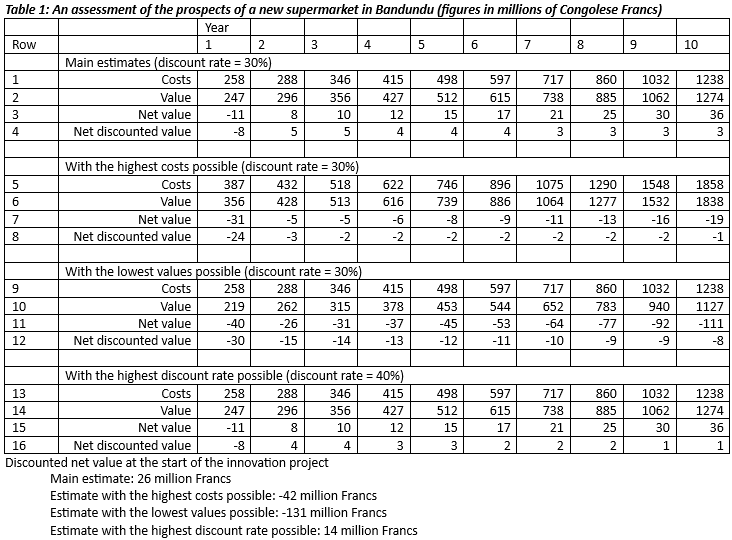 
Comments are closed.
|
Author
The blog and site are written by James Waters. He is a British economist. Archives
July 2024
Categories
|
||||
 RSS Feed